
Shaping Organisational Culture and Leadership Culture Effectively
A strong organisational and leadership culture does not grow out of mission statements alone, but above all from what people actually experience in their everyday working lives. Through workshops, consultancy and targeted development impulses, we support organisations in shaping leadership, collaboration and change in ways that strengthen motivation, employee retention, future readiness and effectiveness. Especially in challenging times, this builds organisational resilience and helps organisations navigate complexity more effectively.
What really shapes organisational culture and leadership culture in organisations
Organisational culture describes the values, norms and attitudes that shape decisions, behaviour and collaboration within a company. Leadership culture is always part of this, because leaders influence every day how people work together, communicate, learn and deal with challenges.
What matters, therefore, is not only what is written in mission statements or brochures. What matters above all is what employees and leaders actually see, hear and experience in everyday working life. That is where organisational culture becomes tangible.
Developing organisational culture: from mission statement to lived reality
There is the culture described in presentations, mission statements and on websites. And then there is the culture that is actually lived within the organisation: in leadership, collaboration, feedback, willingness to learn and the way mistakes are handled.
If you walk through your organisation, do you experience openness, appreciation and constructive collaboration? Or do you encounter uncertainty, distance, silo thinking and restraint? Lived culture does not reveal itself in glossy images on the wall, but in behaviour.
The real organisational culture is what is genuinely lived in everyday working life.
For the desired organisational and leadership culture to become reality, good intentions are not enough. It requires the deliberate development of attitude, behaviour, communication and day-to-day leadership.
Why strong organisational and leadership culture strengthens connection
Organisational culture, leadership culture and the culture of collaboration are key factors in creating a sense of connection within an organisation — and therefore also in strengthening employee retention. People are more likely to stay where they feel seen, valued and taken seriously, where they experience meaning in their work, can grow and perceive their leader as supportive. From our perspective, the goal is therefore not primarily to “retain” employees, but to strengthen their emotional connection to the organisation, its values, its lived culture, their team and their leader.
This sense of connection makes a real difference in everyday working life. When people feel that they belong, that their needs are recognised and that they are working in a culture of trust, not only does motivation grow. So do their willingness to take responsibility, their level of engagement and their readiness to contribute their own strengths. Organisations that make good leadership, clear orientation, appreciation and strong collaboration tangible are therefore perceived as more attractive employers and create better conditions for people to stay and contribute over the long term.
Organisations that make good leadership, orientation, appreciation and strong collaboration genuinely tangible are therefore perceived as more attractive employers and create better conditions for people to stay willingly and contribute over the long term.
An organisational culture that strengthens connection is therefore not a soft factor, but a strategic lever for employee retention, future-readiness and business success.
Viewing organisational culture across 7 levels
Organisational culture emerges through the interaction of several levels. This perspective helps to understand and develop culture not only superficially, but systematically.
- Environment
How do spaces, structures and general conditions support good work, dialogue and orientation? -
Behaviour
How do people in the organisation interact in everyday life? How are feedback, collaboration, mistakes and conflicts actually handled? -
Capabilities
How well are employees able to contribute, develop and use their strengths effectively? -
Values
Which values really shape decisions and behaviour in everyday life? What applies not only officially, but in practice?
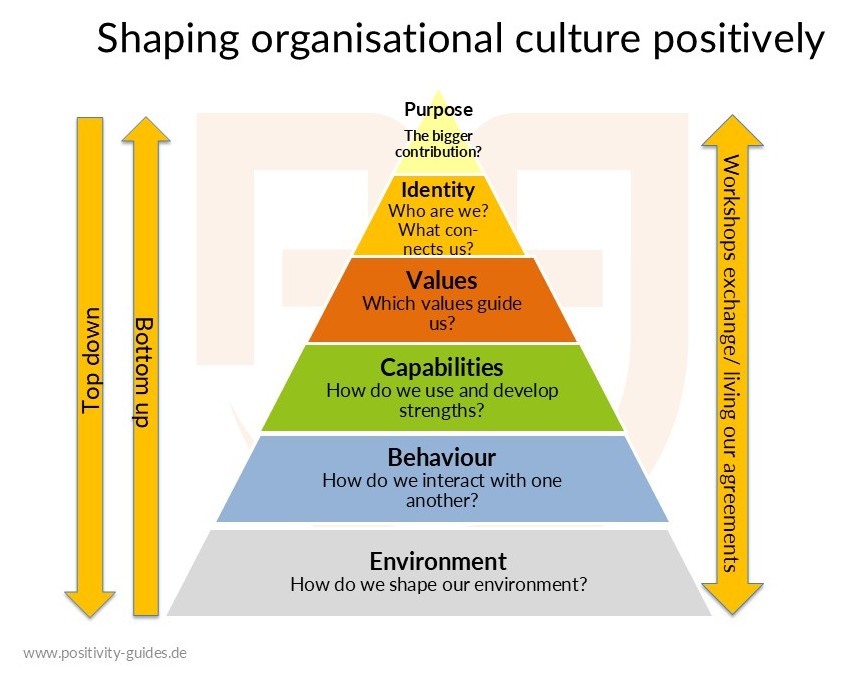
- Identity
What do we stand for as an organisation? What connects us internally, and what do we want to be clearly recognised for externally? - Meaning
What contribution do we make for customers, employees and society? What gives our actions direction and significance?
Positive Psychology offers many effective ways of shaping organisational culture positively. Even small steps can have an impact. The more people within the organisation contribute to this, the more strongly organisational culture, leadership culture and collaboration can develop.
Positive Transformation: shaping change in a people-centred and effective way
For us, Positive Transformation means applying Positive Psychology and Positive Leadership deliberately within change processes. In this way, we shape change not only effectively, but above all in ways that are people-centred, constructive and future-ready.
Especially during transformation, digitalisation initiatives and the implementation of artificial intelligence, many people experience uncertainty, overload or the concern that they are not being sufficiently taken along. Positive Transformation begins precisely here: it takes people, their needs, their perceptions and their fears seriously.
Instead of steering change only through targets, processes and structures, Positive Transformation also focuses on what is already working, on existing strengths, on successful collaboration and on helpful resources. At the same time, it is about naming fears openly, clarifying needs and shaping change in ways that help people feel understood, involved and taken seriously.
This creates a process of change that is not only accepted more quickly, but unfolds more constructively. People feel heard, their needs are addressed and they are more willing to take responsibility and help shape the future.
Positive Transformation combines pressure for change with humanity, clarity and genuine participation.
That is exactly why, for us, Positive Transformation is an important approach to cultural development, change processes, digitalisation and the introduction of new technologies. It helps organisations shape change effectively without losing sight of people.
Vision Zero: Prevention as part of a people-centred corporate culture
A people-centred corporate culture is evident not only in leadership, collaboration and change, but also in how consistently safety, health and wellbeing are taken into account in day-to-day operations. This is precisely where Vision Zero comes in: as a prevention-oriented approach that aims to prevent avoidable suffering and promote a working environment in which people can work healthily, safely and effectively. Positive leadership can make an important contribution to this, because a culture of prevention is always also a culture of leadership. You can read more about this on our page Positive Leadership – Key to Vision Zero.
Change, digitalisation and AI work better when people are meaningfully involved
Change becomes more sustainable when people are not merely informed, but genuinely involved. This applies to classic change processes as much as to digitalisation, new ways of working and the implementation of artificial intelligence.
Anyone who wants to shape transformation effectively must provide orientation, strengthen psychological safety, enable dialogue and make it understandable what is changing, why it is changing and what employees concretely need in order to move forward well with it.
In this way, change becomes not merely a project that has to be delivered, but a development process that people can actively support. That is precisely where organisational culture, leadership culture and Positive Transformation come together.
How we support you in developing your organisational and leadership culture
Positivity Guides® supports organisations in shaping cultural development, change and Positive Transformation in ways that are well-founded, human and practical. Together with you, we create clarity about the culture you want to strengthen, what is already being lived today and which concrete next steps make sense.
- Workshops for reflecting on and developing your organisational culture
- Consultancy on shaping a strengths-based leadership culture
- Support for change, transformation and digitalisation processes
- Impulses for better collaboration, motivation and employee retention
- Practical support with the people-centred introduction of new ways of working and technologies
- Development impulses for leaders, teams and organisations
Let us talk about your organisational culture, leadership culture or Positive Transformation
If you would like to learn more about how we can support you with organisational culture, leadership culture and Positive Transformation, please call us on +49 (0) 30 893 77 950 or write to kontakt@positivity-guides.de