
Positive Psychology in Organisations
Positive Psychology is the scientific foundation of Positive Leadership, effective organisational culture, motivation, connection and positive transformation. At Positivity Guides, we make these insights practical and usable for companies, leaders and organisations — for happy people in successful organisations.
What is Positive Psychology?
Positive Psychology broadens the perspective of traditional psychology. It does not only ask how people cope with strain, crises or problems, but above all what strengthens people, what helps them flourish, and what contributes to greater wellbeing, motivation, development and successful collaboration.
At the centre are questions such as: What helps people live and work in ways that are healthy, engaged, effective and connected? What fosters trust, meaning, hope, positive relationships and development? This is precisely why Positive Psychology is so relevant for organisations: it provides scientifically grounded insights into how people and organisations can become stronger.
The fundamental shift in perspective
Positive Psychology complements the traditional focus on illness, errors and deficits with a second, equally important perspective: strengths, resources, capabilities, development and positive experience. In other words, it is not only about repairing what is wrong, but also about deliberately developing what makes people and systems strong.
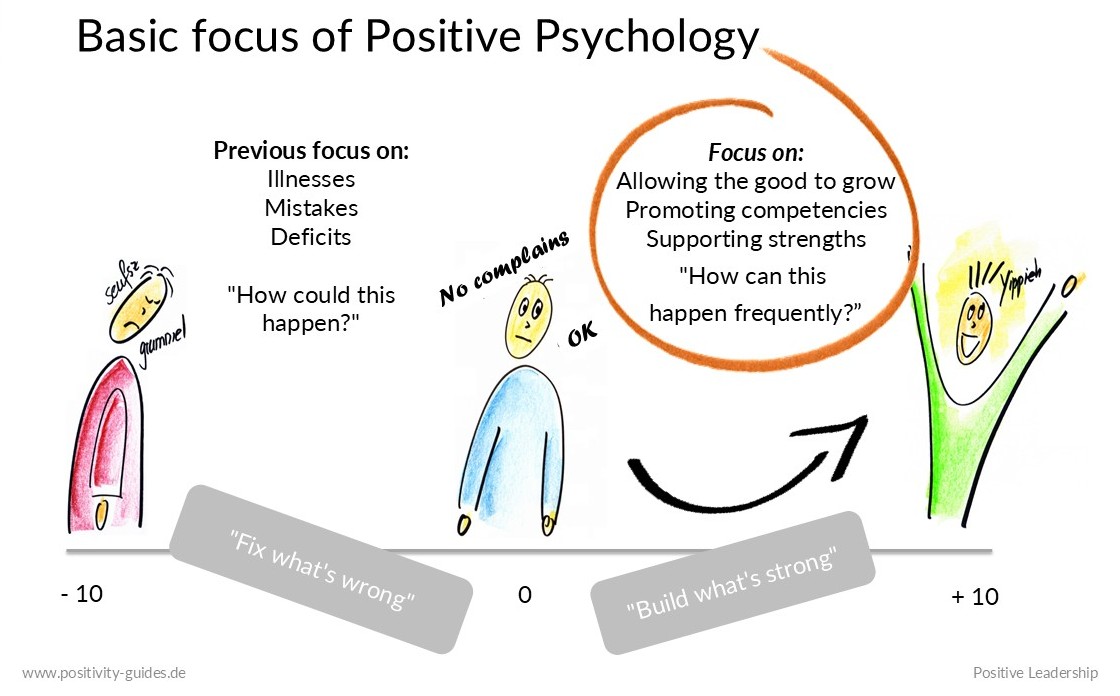
Positive Psychology shifts the focus from “fix what’s wrong” to “build what’s strong” — from repairing problems to consciously strengthening resources, capabilities and positive development.
The PERMA model as a foundation of Positive Psychology
A central model in Positive Psychology is Martin Seligman’s PERMA model. It describes five areas that contribute significantly to wellbeing, development and a flourishing life: positive emotions, engagement, relationships, meaning and accomplishment.
PERMA ist für uns das theoretische Herzstück. Es hilft, Positive Psychologie nicht nur abstrakt zu erklären, sondern konkret zu strukturieren. Im Unternehmenskontext wird damit sichtbar, an welchen Stellen Führung, Zusammenarbeit, Kultur und Entwicklung Menschen stärken oder schwächen.
Why PERMA is so valuable for organisations
PERMA makes it clear that good work is not only about performance. People also need positive relationships, meaning, motivation, tangible progress and spaces in which they can use their strengths. That is exactly what makes Positive Psychology so relevant to leadership development, organisational culture and positive transformation.
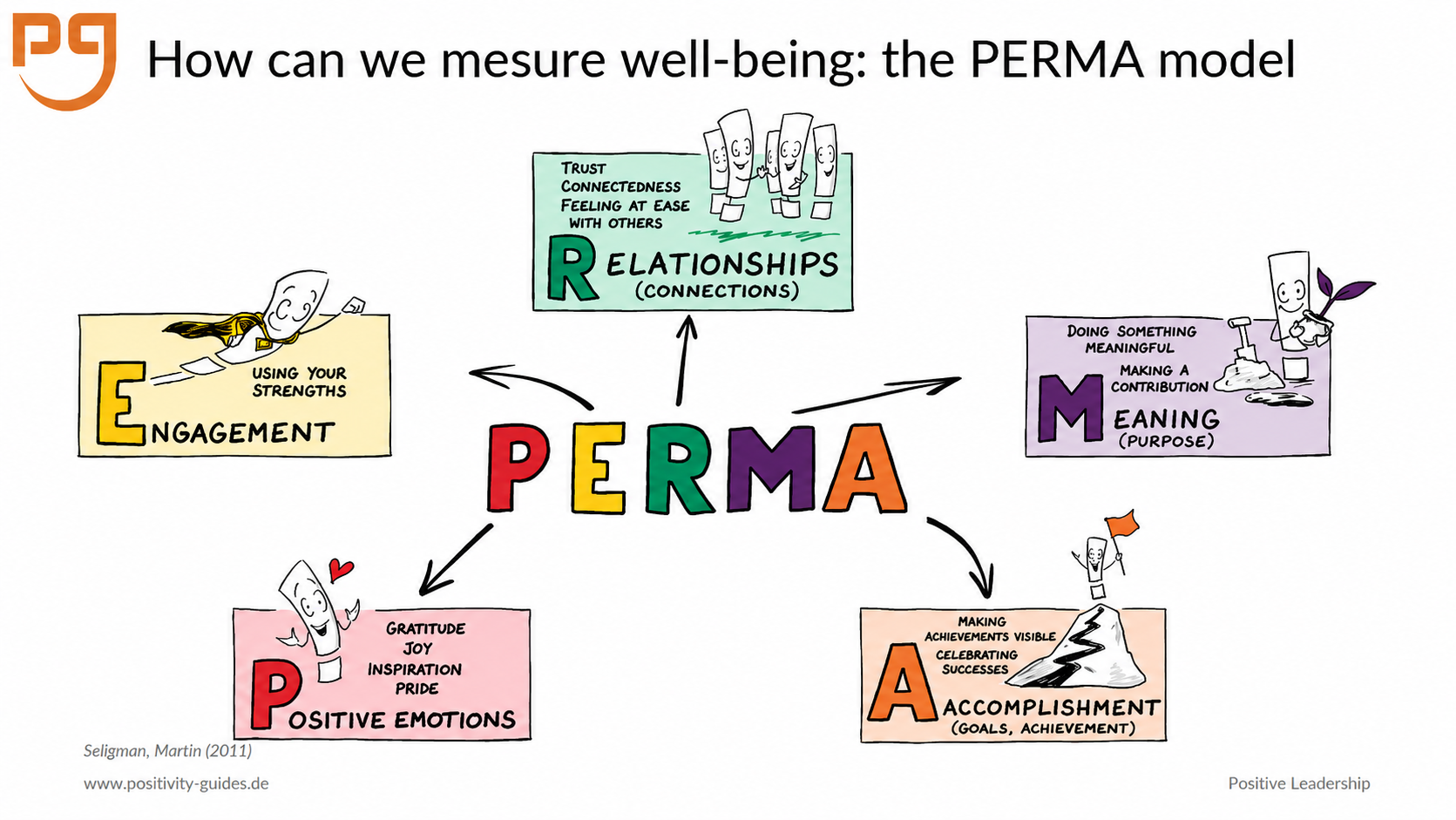
PERMA stands for Positive Emotions, Engagement, Relationships, Meaning and Accomplishment — the five central dimensions of flourishing and wellbeing.
P – Positive Emotions
Positive emotions such as joy, confidence, gratitude, interest and hope broaden perspective and strengthen energy, openness and psychological resilience. In everyday working life, they help people think more constructively, act more creatively and deal with challenges more effectively.
For organisations, this matters because positive emotions can make collaboration easier, strengthen the ability to learn and improve the way people deal with uncertainty. Positive emotions do not mean ignoring problems; they mean strengthening the inner resources that help people remain capable of taking action.
E – Engagement
Engagement describes the active, wholehearted involvement in tasks, strengths and development. People experience greater motivation and effectiveness when they can use their abilities in meaningful ways and become fully absorbed in their work.
In an organisational context, engagement is a particularly important lever: leadership, culture and job design strongly influence whether people merely do the minimum required or truly contribute their strengths, energy and sense of responsibility — and whether that contribution is actively encouraged by their leader.
R – Relationships
Positive relationships are a vital foundation for trust, collaboration, psychological safety and connection. In organisations especially, good relationships with colleagues, teams and leaders have a strong influence on motivation, health and commitment.
For organisations, this is important because positive relationships foster trust, psychological safety and constructive collaboration. This creates greater openness, better alignment, stronger connection and a working environment in which people are more likely to contribute their potential, learn from one another and remain genuinely committed to the organisation.
M – Meaning
Meaning arises when people experience their work as significant and as contributing to something important. Meaning provides direction, strengthens identification and is especially helpful in times of change and uncertainty.
For organisations, this matters because a sense of meaning significantly strengthens motivation, identification and a sense of belonging. When employees understand why their work matters, how it contributes to the bigger picture and why shared goals are meaningful, it creates greater orientation, responsibility and an inner willingness to stay engaged even in times of change.
A – Accomplishment
Goal achievement and visible success strengthen self-efficacy, enjoyment of learning and motivation. People need to experience that their work has an impact, that progress is possible and that results become visible.
For organisations, this is important because visible success strengthens self-efficacy, enjoyment of learning and willingness to perform. When progress, interim successes and goal achievement are consciously noticed, recognised and celebrated, this increases motivation, makes development tangible and supports a culture in which people move forward with confidence.
The humanistic foundation of our approach
Our work with Positive Psychology is based not only on models, but also on a clear underlying attitude. At the centre is each person — with dignity, capacity for development, vulnerability and potential. We work from a humanistic foundation that does not reduce people to functions, but takes them seriously.
- The dignity and uniqueness of every person
- Acceptance and respectful interaction
- Diversity as an enrichment
- Inclusion and belonging
- A strengths-based perspective instead of deficit fixation
- Development instead of shame
- A focus on resources instead of a purely error-based perspective
This attitude shapes the way we view leadership, collaboration and organisational culture. For us, Positive Psychology is therefore not just a method, but also an expression of how we understand people and organisations.
A strengths-based perspective instead of deficit fixation
A central feature of Positive Psychology is the deliberate focus on strengths, resources and what is already working well. People tend to develop particularly well where they can recognise, use and further develop their strengths. In organisations especially, a strengths-based perspective helps to foster motivation, fit, development and effectiveness more intentionally.
A strengths-based perspective does not mean ignoring problems. It complements the focus on strain and deficits with the question of what strengthens people, what is already working and what can be built on meaningfully. That is exactly what makes Positive Psychology so relevant to organisations, leadership and cultural development.
Psychological basic needs
One important contribution of Positive Psychology is that it helps explain what people psychologically need in everyday working life in order to remain motivated, healthy and engaged. Four basic needs are particularly important:
- Autonomy – scope to shape one’s work, take responsibility and participate
- Competence – experiencing oneself as effective and capable of achieving results
- BRelatedness – trusting, constructive and authentic connection
- Meaning – experiencing that one’s work matters
Where these needs are well addressed in organisations, motivation, willingness to learn, health, connection and the readiness to take responsibility all increase.
Feedback makes development visible
Constructive feedback is an important practical lever of good leadership. It provides orientation, strengthens self-efficacy, makes progress visible and supports people in developing more intentionally. Positive Psychology therefore understands feedback not only as correction, but also as strengthening, clarification and a developmental impulse.
The interaction with psychological basic needs makes clear why good feedback is so effective: it can make competence tangible, strengthen relationships, create safety and help people recognise more clearly the meaning and development in their work.
What is Positive Business?
Positive Business is the application of Positive Psychology in companies and organisations. It explores what people need at work in order to be effective, healthy, motivated and connected — and how organisations can at the same time become more successful, more attractive and more future-ready.
In this way, Positive Business brings together the human factor and the effectiveness factor. It provides scientifically grounded insights and practical impulses for leadership development, motivation, employee retention, teamwork, cultural development and positive transformation. Positive Business therefore does not focus only on problems, strain or deficits, but on the conditions under which people and organisations can grow, learn, cooperate and make better use of their potential.
This is precisely where the particular strength of Positive Business lies: it makes Positive Psychology concretely usable for organisations. It helps explain how leadership, collaboration, communication, meaning, a strengths-based approach and sustainable relationships can be shaped so that people experience themselves as effective, valued and connected — while organisations at the same time become more capable and more resilient.
Positive Psychology becomes practically relevant in organisations
In an organisational context, Positive Psychology becomes especially relevant where the focus is on motivation, collaboration, employee retention, leadership, culture and positive transformation. It helps create psychologically sustainable conditions for performance and wellbeing rather than merely managing symptoms.
In practical terms, this means that Positive Psychology provides organisations with a scientifically grounded frame of reference for how motivation can be strengthened, connection encouraged, leadership made more effective and change supported in a more constructive way. It thus becomes an important foundation for modern leadership development, healthy collaboration and an organisational culture that strengthens people while enabling performance.
Positive Business therefore offers organisations a framework that is both scientifically grounded and highly practical, helping them bring the human factor and the effectiveness factor together more successfully. That is exactly why Positive Psychology is so relevant for organisations today: it helps shape motivation, connection, leadership, collaboration and change not only intuitively, but in ways that are grounded and effective.
Why Positive Psychology is relevant for organisations
Positive Psychology helps organisations understand what intrinsically motivates people: autonomy, self-efficacy, good relationships, meaning, suitable tasks and the opportunity to use their own strengths. Motivation is therefore understood not only as a reaction to incentives, but as the result of good conditions in which people experience themselves as effective, included and meaningfully involved.
That is exactly why Positive Psychology is so valuable for organisations: it connects motivation with an understanding of people, with leadership, with culture and with the concrete design of work. This helps explain why good leadership, meaningful tasks, sustainable relationships and a strengths-based culture have such a strong influence on engagement and willingness to perform.
Positive Psychology helps to
- strengthen motivation
- foster connection within the organisation
- positively influence employee retention
- make leadership more effective and more human
- support health and wellbeing
- further develop collaboration and organisational culture
- support change in a more constructive way
What motivates people at work
Positive Psychology helps organisations understand what intrinsically motivates people: autonomy, self-efficacy, good relationships, meaning, suitable tasks and the opportunity to use their own strengths. Motivation is therefore no longer seen primarily through pressure, control or external incentives, but through psychologically sustainable conditions.
That is exactly why Positive Psychology is so valuable for organisations: it connects motivation with an understanding of people, with leadership, with culture and with the concrete design of work.
Why this creates connection and commitment
Where people experience themselves as effective, connected, meaningfully involved and appreciated, their emotional commitment to their team, their leader and their organisation usually grows as well. Positive Psychology therefore strengthens not only motivation, but also connection, collaboration and the willingness to take responsibility over the long term.
The Gallup Engagement Index Germany 2025 shows how relevant this is: only 10% of employees in Germany are highly emotionally committed; at the same time, the German economy lost at least €119 billion in 2025 due to disengagement and the resulting productivity losses. Gallup also reports that highly committed employees have 41% lower absenteeism than employees without such commitment.
This makes clear how closely motivation, connection, leadership and organisational success are linked.
From Positive Psychology to Positive Leadership
Positive Psychology forms the scientific foundation of our approach to leadership development. In that context, it is translated into practice through Positive Leadership — an understanding of leadership that strengthens people, makes potential visible, conveys meaning, fosters relationships and enables development.
For us, Positive Leadership is the consistent translation of Positive Psychology into effective leadership behaviour. It is about how leaders create an environment in which people work with greater engagement, contribute their strengths, experience trust and at the same time remain effective and capable of high performance.
With the PERMA-Lead model, we make this approach concrete and trainable within leadership development. In this way, theoretical knowledge becomes a clear, applicable and practically effective developmental approach for leaders, teams and organisations.
What this means for organisations
Organisations that deliberately develop Positive Leadership strengthen not only individual leaders, but also motivation, connection, collaboration and future-readiness. That is exactly why, for us, Positive Psychology is not the end of the explanation, but the beginning of practical leadership development.
Explore leadership development
From Positive Psychology to organisational culture and positive transformation
Our work on organisational culture, leadership culture and positive transformation is also rooted in Positive Psychology. Themes such as connection, meaning, trust, relationships, motivation and psychological safety are carried forward at organisational level and translated into the practice of collaboration and change.
Especially in times of transformation, digitalisation, cultural change and the introduction of new ways of working, Positive Psychology helps ensure that people do not disappear from view. It strengthens understanding of what people need in order to engage constructively with change, feel heard and channel their energy in meaningful ways.
For us, positive transformation therefore means shaping change in a people-centred way: with a clear focus on needs, resources, fears, meaning, belonging and sustainable relationships. In this way, Positive Psychology becomes not only a way of thinking, but also a practical contribution to effective culture work and transformation processes.
What this means for organisations
Organisations that use Positive Psychology in cultural and change processes create better conditions for motivation, participation, connection and sustainable development. That is exactly why it is also a central foundation of our work on organisational culture.
Explore organisational culture
Positive leadership works!

Our book brings together scientific grounding and concrete practice for leaders, teams and organisations.
Our theoretical foundation is also developed in depth in the book
In our book “Positiv führt! Mit Positive Leadership Teams und Organisationen empowern”, we show how Positive Psychology and Positive Leadership can become effective in the world of work — through trust, empathy, mindfulness, hope, meaning and concrete leadership skills.
The book combines scientific grounding with many years of practical experience and shows how Positive Psychology can be translated into leadership, collaboration, organisational culture and positive transformation. In doing so, it underlines the very foundation on which our work with organisations is built.
Written by practitioners for practice
The book has been deliberately designed not only to convey theoretical background, but also to be directly useful in practice. A substantial practical section with concrete applications, exercises and impulses supports leaders and organisations in making Positive Leadership and Positive Psychology effective in everyday working life.
The book is complemented by additional materials and a download area, so that scientific grounding becomes concrete, practical development for organisations.
More about the book
Let us make Positive Psychology work in your organisation
Would you like to make Positive Psychology effective in leadership, collaboration, organisational culture or change processes? Then speak with us about how scientific insights can be implemented in your organisation in ways that are meaningful, practical and human.
+49 (0) 30 893 77 950
kontakt@positivity-guides.de